Download article
In this article, we shall see how experiential learning, made possible through gamified training, encourages the necessary shift in perspective on learning and the organisation's evolution. This change, together with the power of simulations, turns simulation games into a unique tool for understanding systemic, complex, and dynamic realities.
SIMULATION GAMES, a learning tool.
Gaming and simulation combine cognition and emotion, to allow participants to understand and integrate dynamic and complex contexts.

By downloading this article, you agree to be included in a distribution list to keep you informed about the Training Games activities.
We occasionally send a few emails with very brief information.
Your email address is used only for that purpose, and you can always use the Unsubscribe link included in all our communications.
We do not share any email or downloaded information with any third party.
The difficulty in predicting the future generates enormous uncertainty in all organisations.
Organisations' stances on rapid, profound change require a high capacity for internal adaptation, which requires skill and flexibility in making continual internal adjustments to the organisation, reflecting the external conditions of the time (1).
As far as people are concerned, we have an insufficient capacity to understand and act in this global, complex world. Organisations must rely on sufficiently skilled, committed, and self-organised teams to react quickly at the local level within a global strategy. Strategic positioning in turbulent conditions requires, first and foremost, a team free of prejudice, with a positive attitude towards change grounded in commitment (2).
Today, the ability to learn dynamically is becoming increasingly important, at both individual and organisational levels, to apply the necessary changes to facilitate adaptation to the environment. There is a need for instruments capable of reflecting highly interrelated, complex natural systems in a way that is easy to understand and enables rapid integration of information. This knowledge, integrated by self-organised groups, will enable rapid, adaptive responses.
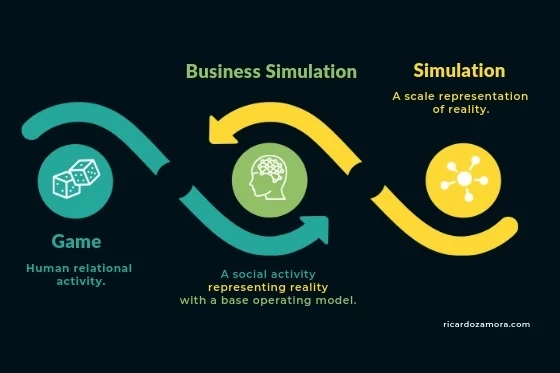
New training disciplines based on business simulation games can take dramatic advantage of the creation of explicative models (System Dynamics). These models are based on systemic concepts of social and economic reality (Systems Thinking) and fully exploit the power of new technologies to develop simulations (Business Simulations) that can be used in university and other organisational dynamics, such as businesses. A result is a form of living-learning that, by combining cognition and emotion, enables the participant to understand and integrate dynamic, complex contexts.
References
Perhaps you would be interested in the following:
- Our recognised leading in-person simulation to create emotional links and develop participative leadership is here.
- Our virtual business simulation for global communities is here.
- Our team dynamics programmes to improve managers’ interrelations are here.
- Our development programme to become a team player is here.
- Our games for training or motivational purposes at courses, meetings or events are here.